
Kashima-san’s Distance
The Character of RainThis flow traces Kashima-san's refusal of the child's adoration and culminates in her silent presence during the pool crisis.
increasing Bearing strength in each event
 decreasing
Bearing strength in each eventdecreasingA Displaced Aristocrat
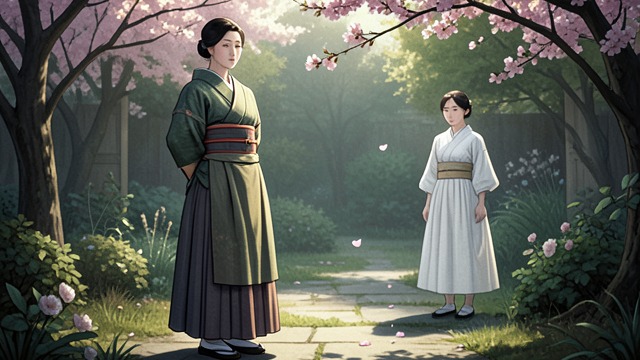
A Displaced Aristocrat
A changed social order
Kashima-san comes from a Japanese aristocratic family deprived of its title and wealth after the war. She accepts household work with dignity but resents the white family she serves.
Contempt as self-protection
Her refusal to defer to Mother or Father reflects an older grievance and a rigid sense of rank. The household cannot easily fit her into its ordinary expectations of service.
The Unbelieving Nanny

The Unbelieving Nanny
A solitary dissenter
The Narrator (God) treats Japanese caregivers and neighbors as followers, but Kashima-san refuses this private religion. Her lack of admiration seems incomprehensible to the child.
A limit to divine power
Attempts to charm and impress Kashima-san fail. Her indifference reveals that the Narrator (God) cannot command another person’s affection.
A Theory of Restraint
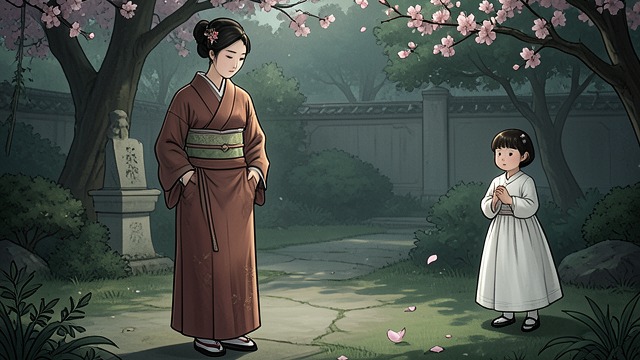
A Theory of Restraint
Joy rejected
Kashima-san responds coolly to flowers, food, rainbows, and the child dressed in a kimono. The Narrator (God) interprets her reserve as a disease of self-denial.
A partial explanation
The child sees her emotional restraint clearly but misunderstands its causes. Its diagnosis reflects an emerging theory that people reveal themselves through their responses to pleasure.
The Silent Witness
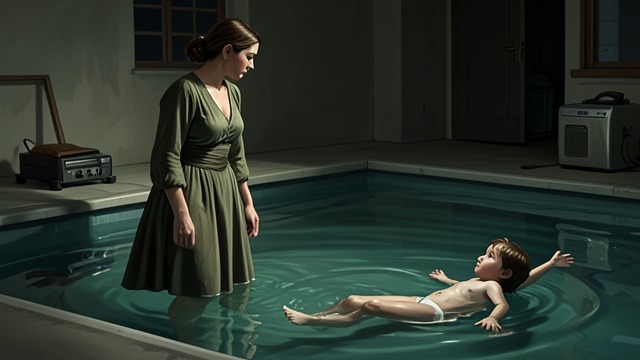
The Silent Witness
Watching the child drown
Kashima-san sees the Narrator (God) submerged in the pool and does not intervene. The child, suspended in water, assumes that she understands and accepts its choice.
A lasting ambiguity
The Narrator (God) later wonders whether Kashima-san recognized the act as intentional. The account cannot establish her motives, and her silence remains morally charged.
No Confession Afterward
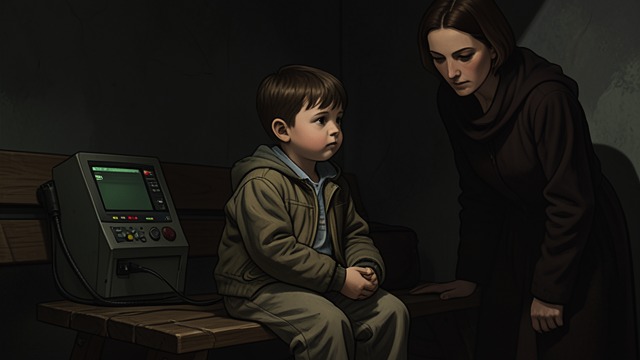
No Confession Afterward
A secret kept
The child never tells the parents that Kashima-san watched and did not act. The omission protects Kashima-san from consequences while preserving uncertainty about what she understood.
A relationship unresolved
Kashima-san and the Narrator (God) never receive an explicit reconciliation. Their connection remains shaped by hostility, fascination, and the unspoken memory of the pool.
When Kashima-san joins the household
At age two and a half
Spring 1970, during the child’s experiments
August 1970, during the koi-pool crisis
After the rescue in August 1970
